


close
Develop, support, promote disability leaders

Tag Archive: leadership

  1. Human Not Robots

    A line of boxy worker type robots with 6 wheels following each other.

    Humans not robots

    time to reclaim human

    by Christina Ryan, DLI CEO


    Productivity growth is lagging, and yet organisations keep approaching work in the same way that they have done for decades. At the same time there is a move away from diversity and inclusion as if that is part of the problem, rather than a potential solution.

    Fundamentally, work still follows the model set out several centuries ago where people have a workday of set hours, attend a generically designed workplace, work on achieving outcomes, then go home. Furthermore, workplaces have become places where people of similarity clump together in groups of people just like them; people from a similar background, cultural grouping and similar pathway of education and attainment, because that is what is considered “qualified” for the work being done.

    While remote work has shifted the dial over recent years, physical workplaces are still designed a certain way and with expectations that most workers will attend them and be productive in them. Yet large numbers of people find modern workplaces difficult to work in.

    It’s time to pause and consider what might happen to productivity if workplaces were designed for the humans in them. To consider what might happen to productivity if diversity really was allowed to be diverse, if people could operate in the way that best suited them.

    How much might innovation and productivity lift if we stopped expecting humans to become robots?

    A key question for modern workplaces is: who decides what they look like? Who makes the ultimate decisions about the design of “work” and workplaces? It appears these crucial decisions are made by people who look the same as the people who have always held decision making positions. If the final decision makers are the same sorts of people who have been making the decisions since time immemorial how will anything ever change?

    Disabled people are rarely in those corridors of power. Rarely in the big corner office. Rarely in the cabinet room. Rarely approving the design, layout, and budgets committed to constructing how humans work. It should come as no surprise, then, that those workplaces often don’t work for people who operate differently, including disabled people.

    Big open plan offices, shared desks, bright lights, phone calls in the open, strict parameters on operational hours, might suit those drawing up budgets and doing office planning, they might achieve good looking bottom lines, but rather than suit humans they end up turning us into robots.

    As humans move more deeply into the 21st century, perhaps it’s time to allow ourselves to be more human in how we work and to recognise that it might, just might, contribute to productivity if people are working in ways that suit the people who are doing the work.

    Sign up for regular updates from the Disability Leadership Institute. 

    Christina Ryan is the CEO of the Disability Leadership Institute, which provides professional development and support for disability leaders. She identifies as a disabled person. 

  2. DLI Members in the news – September 2025

    Heidi La Paglia Reid – Sydney hosts world’s largest women’s shelter conference

    Morwenna Collett – MSO launches Disability Inclusion Plan

    Lisa Cox – Current standard treatment of deadly sepsis ‘ineffective, envy harmful’

    Katie Kelly – i did it – Register for your race bib and enter the Casino Fun Run

    Laura Pettenuzzo – The leadership program building support and community for young people with cerebral palsy

    Laura Pettenuzzo – Minister Butler’s NDIS language missed the mark but let’s not miss the bigger picture

  3. Meaning well doesn’t equal inclusion

    This month we are revisiting an article from February 2020:

    Meaning well doesn’t equal inclusion

    Real inclusion takes action as well as good intentions.

    by Christina Ryan DLI CEO

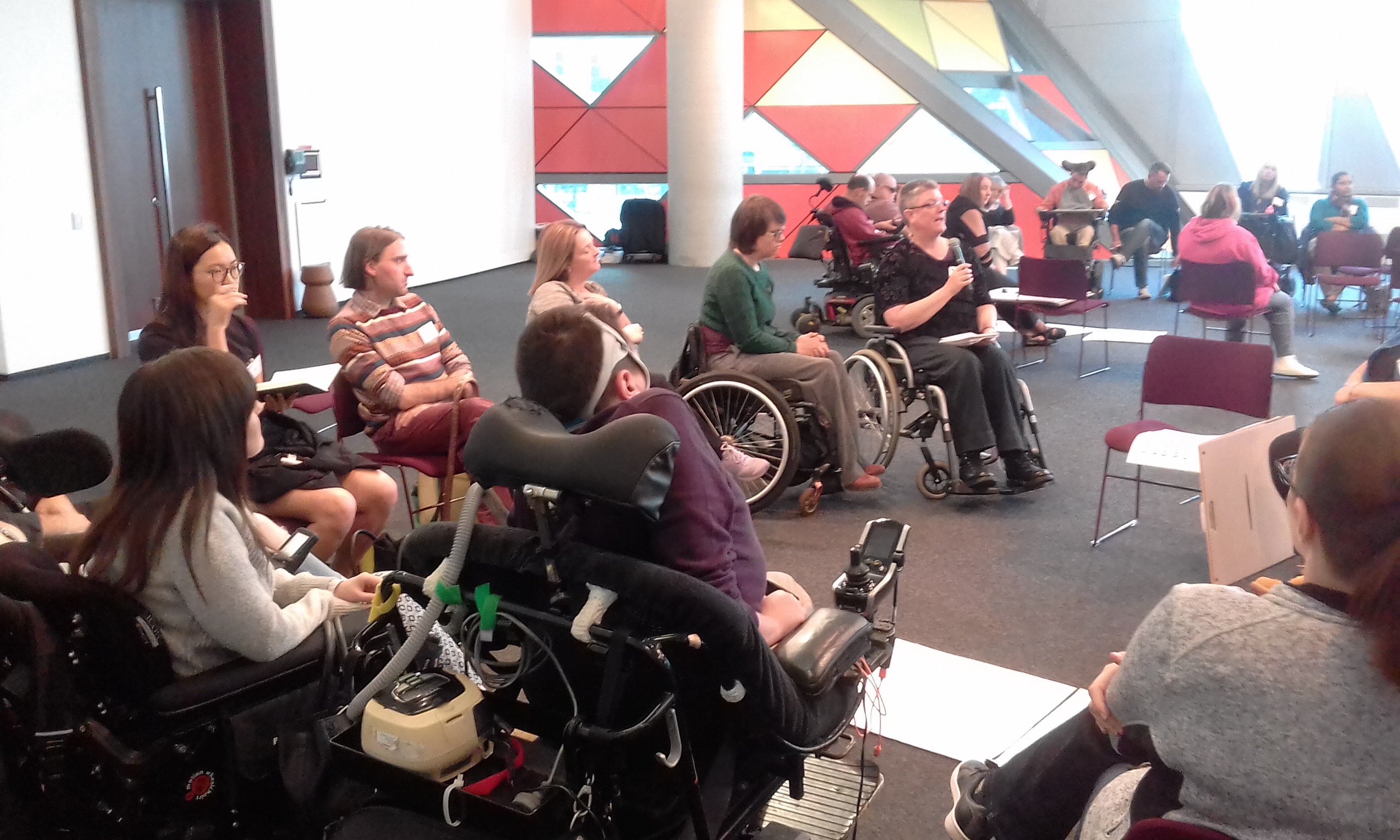
    A group of disabled people in a circle at a conference. Some are in wheelchairs, they are talking together.

    It’s unusual to meet someone who doesn’t think it’s a good idea to employ disabled people, or to be working towards an inclusive workplace.

    So, why is it still so hard to find good workplaces that are inclusive where disabled people feel comfortable and stay for the long haul? Why have the statistics on disability employment stagnated for decades, or gone backwards?

    Because everybody thinks they’re doing something, and very few are.

    Disability Leadership Institute (DLI) members recently shared their experiences of workplace inclusion. They identified that workplaces still aren’t getting inclusion right, with a continuing lack of real action, and despite many workplaces claiming they are inclusive.

    There is no doubt employers mean well, but is meaning well enough to get inclusion over the line? Unfortunately not. Meaning well doesn’t equate to action, and it is real action that is needed.

    DLI members had several comments and suggestions for getting inclusion right across a range of workplace touch points. Many of these suggestions come from managers of teams, CEOs, and highly qualified disabled people struggling to find work. All the suggestions are from disabled people as both practitioners of inclusion and participants in inclusive processes.

    Inclusion needs to start at the beginning, during recruitment, and continue as an ongoing focus for management and leadership every day. Complacency is not an option. Never assume your organisation is fully inclusive, nor that you have no further work to do. There is always more to be done, just as there are always more ways of being inclusive, because diverse people are diverse and each person must be treated as an individual.

    Recruitment:

    • Contacting people before their recruitment interview, or appraisal process, to ask what adjustments need to be made and then making those adjustments
    • Making sure interviewers can respond to questions about workplace adjustments at interview
    • Ensuring interviews are accessible so that people can focus on their interview and not their disability needs
    • Ensuring people are confident and comfortable asking for adjustment during the recruitment phase, this means having an accessible recruitment process
    • Providing questions before interview, meeting interview panel members beforehand, or not even having a formal interview process
    • Openly seeking disabled people for your workforce

    Human Resources:

    • Ensuring there are disabled people working in human resources, and valuing the expert contribution of those staff
    • Asking all staff how they like to work/communicate and then creating shared profiles with that information, so everyone knows that everyone one else has particular strengths and preferences
    • Collecting data on diversity numbers and length of employment, including how many people openly identify as disabled

    Management:

    • Taking organisation level policies and applying them at team level
    • Ongoing conversations amongst team members which may lead to flexible work arrangements on where and how work is done
    • Doing regular things like staff meetings and team gatherings in open reflective ways

    Leadership:

    • Leadership leading by example, making sure all team members are checked on as part of daily routines to avoid exclusion and cliques developing
    • Maintaining an open conversation about gaps in inclusion and openly working to address those gaps
    • Workplaces claiming to be diverse should be planning, providing funding and seeking counsel for success in diversity, just as they would any other part of their business mission

    Finally, and rather obviously: having more than good intentions by actually employing disabled people. Many organisations say that employing disabled people is a good thing to do, yet half of all disabled people remain unemployed.

    Clearly good intentions are not good enough. Workplaces need to mean it and that means action.

    Action starts from recruitment and continues throughout the organisation as part of daily operations. Action means policies, processes and an ongoing conversation about what inclusion looks like for this team.

    Action also means management openly taking responsibility for addressing inclusion gaps as a leadership example.

    Inclusion will look different for every team, because every team is different; however, there are some structural underpinnings that can be considered for any organisation that wishes to be inclusive, as well as being seen to be inclusive.


    Thanks to the many DLI members who shared thoughts and experiences for this article.

    Sign up for regular updates from the Disability Leadership Institute. 

    Christina Ryan is the CEO of the Disability Leadership Institute, which provides professional development and support for disability leaders. She identifies as a disabled person

  4. Launches and more launches

    A rocket launching into space

    By Christina Ryan DLI CEO

    Endlessly starting but never finishing


    Most of us enjoy a nice morning tea. The chance to catch up with colleagues, move away from our desks, and celebrate something over tea and cupcakes.


    For the disability community many of these morning teas are centred on launching Disability Action Plans in one form or another. Months, even years, of work can go into developing a good action plan and celebrating that with a launch is a great thing to do. Acknowledging all the consultation and codesign work, the contributions of many people, and the beginning of a new era for organisations as they turn towards a more inclusive future.


    What we don’t see, though, are morning teas to celebrate the outcomes of those plans. What happens at the end of 3 or 5 years when the plan expires? Where are the morning teas that acknowledge the work that has gone into implementing the plan and making the gains that it aspired to?


    Sometimes organisations don’t achieve the aspirational goals they have set. Like all plans and goals, this happens. Rather than admitting that the plan was ambitious and using the lessons learned as a way of doing better in the future, some organisations quietly forget that they made a big fuss and stop talking about their plans. Organisations that once proudly and publicly declared their intentions suddenly go quiet. Some remove their plans from their websites or cease reporting gains in their annual reports. There was a period a few years ago when it was almost impossible to find any mention of Disability Action Plans or their outcomes on government websites. Fortunately, those days seem to be over.


    Where are the morning teas to acknowledge the end of a plan? A celebration of the lessons that were learned, and ownership of any mistakes made. Why are organisations embarrassed by not achieving lofty goals, or by not exactly hitting a target?


    It’s time to start planning end of plan morning teas! While it’s lovely to have a launch and to get excited by what the future might hold, we should also be unafraid of small gains, of not quite reaching big aspirational goals, and of learning from our mistakes. The outcomes that have been achieved should be celebrated. Every small step represents a gain for the disability community, and often gains are few and far between.


    Next time you attend a launch morning tea, ask what the plan is for the outcomes celebration. Whatever those outcomes are they are worth it.


    Sign up for regular updates from the Disability Leadership Institute. 

    Christina Ryan is the CEO of the Disability Leadership Institute, which provides professional development and support for disability leaders. She identifies as a disabled person


  5. Gaps

    A river flowing through a gap in two steep cliffsGaps

    By Christina Ryan, DLI CEO


    Organisations striving to improve their disability diversity want to achieve substantive outcomes. Many are now attempting to measure inclusion.


    Unfortunately, inclusion is a highly subjective concept so measuring it is challenging. What exactly might measuring inclusion look like, and how can it be compared to inclusion in other organisations so that benchmarking across industries becomes possible?


    Rather than measure ephemeral concepts, organisations could achieve more tangible outcomes by measuring gaps. Disability diversity is either present or it isn’t. Measuring gaps across a range of key areas will indicate what progress an organisation has made towards inclusion, while also indicating specific areas for improvement.


    Openly identifying

    Most organisations run an annual staff census to gauge workforce sentiment across a range of areas, including whether people identify as disabled. These surveys are usually anonymous which means people can safely share information that they otherwise would not.


    For at least the last decade most of these workforce surveys return results showing a level of people with disability that is around twice that of people who are known as openly disabled in that workplace. In other words, approximately half of the disability workforce in most organisations is not being open about their disability. This gap is a key indicator of inclusion because it points to the level of psychological safety that is, or is not, present.


    Comparing anonymous reporting levels to openly known levels is a key gap to monitor. The target outcome is parity between the two figures.


    Recruitment

    How many disabled people apply for jobs with an organisation, compared to how many are recruited? This gap speaks to styles of recruitment, advertising, and interview processes; all of which can be adjusted to be more inclusive. Advertising often includes specific requirements which exclude disabled people, and which are often not necessary for the position concerned. Interview processes are held in inaccessible locations or present barriers which do not necessarily produce the most competent person for the job, for example speed writing exercises or rapid problem solving. Adjusting interview processes to reduce barriers has the potential to increase the numbers of disabled people who get recruited.


    Measuring the numbers of people who declare their disability prior to interview, with the numbers of disabled people who actually get a job is another key gap that can be measured over time. The outcome to achieve is application and recruitment levels equivalent to population density.


    Leadership

    A key workforce diversity building block is diverse leadership. It has long been understood that diverse leadership leads to a more diverse workforce.


    Organisations can measure the levels of diversity in their senior leadership teams and on their boards and work to build greater levels across all diversity cohorts. These levels should reflect the population levels of the various diversity cohorts unless the organisation works in a specific diversity area and then the levels would be expected to be much higher for that diversity cohort. The gap between population levels and leadership levels can be addressed through targeted recruitment and career pathway strategies.


    Another element of monitoring leadership is to understand the presence of disability in the broader workforce and whether that is reflected in the presence of disability within the leadership of that organisation. Is disability present across all levels of the organisation or is it clustered at more junior levels? For example, if an organisation has 5 per cent disability levels in its workforce, are 5 per cent of its leadership also openly disabled people?


    Monitoring gaps can provide substantive measurable indicators of how inclusive an organisation is. Monitoring these gaps over time will also indicate whether an organisation is improving. These indicators are not subjective, rather they are based on specific empirical evidence and can be used across a wide range of organisations and industries.


    Sign up for regular updates from the Disability Leadership Institute. 

    Christina Ryan is the CEO of the Disability Leadership Institute, which provides professional development and support for disability leaders. She identifies as a disabled person.

  6. 2023 Finalists Announced, National Awards for Disability Leadership

    MEDIA RELEASE

    13 November 2023

    Finalists announced!

    National Awards for Disability Leadership.

    An outstanding field of 23 Finalists across 7 categories is announced today in the leadup to the National Awards for Disability Leadership. Recipients will be announced on 3 December 2020, International Day for People with Disabilities.

    The finalists illustrate the breadth of work undertaken by disabled people in pursuing equality and recognition for disabled people.

    The 2023 finalists feature a Walkley Award nominee, an appearance activist, an anti-segregation pioneer, an internationally recognised catwalk model, rights activists, a vaccination lobbyist, anti-violence campaigners, LGBTIQ change makers, educators, and film makers, amongst others.

    These Awards reflect what is important to disabled people and the ways that we are effecting change and pursuing equality for our community. They recognise outstanding achievements by individuals and organisations who have significantly contributed to advancing the status of disabled people.

    The Awards will be delivered across seven categories for outstanding achievement or outcomes by disabled people, reflecting the diversity of our community, and the intersectional nature of our lives, including The Arts, Change Making, Rights Activism, Innovation, Social Impact, Inclusion (for intersectional work), and the Lesley Hall Award for Lifetime Achievement.

    The National Awards for Disability Leadership are owned and run solely by disabled people (following the federal government stepping back in 2018), all nominees are disabled people and all those associated with the Awards are disabled people.

    https://disabilityleaders.com.au/disability-leaders/national-awards/  #DisabilityAwards2023

    https://disabilityleaders.com.au/disability-leaders/national-awards/2023-finalists/